Where’s the money in AI?
AI - The biggest listings in history, and the puzzle of profitability
© Talisman Advisors 2026
Two weeks ago, the public stock market accelerated its path to being dominated by AI. Elon Musk’s SpaceX entered the stock market at a valuation of $1.75 trillion and almost immediately hit a valuation of over $2 trillion. Musk became the world’s first trillionaire.
At the same time Anthropic, made a filing to go public at about $1 trillion market capitalization, and OpenAI has a similar ambition. The three biggest IPO’s in history that are helping to reshape the public stock market just as AI will reshape almost every market going forward.
These three companies will sit with the big seven – Google, Microsoft, Apple, Meta, Amazon, Nvidia, Tesla. All with different roles in the AI market and already dominating our lives.
And here’s the puzzle. It is unclear what the profitability of the three businesses will be. One of them, SpaceX, has some signs of profitability in parts of its business. The other two will have to play out. The harder you look at these AI companies the more complex it is to understand their potential profitability and market value.
A market unlike any other
Most industries can be drawn as a chain. Suppliers feed manufacturers, who feed distributors, who reach customers; each link has its place and each link has a handful of rivals. The artificial intelligence sector doesn’t work this way. It is a web, not a line — a tangle of companies that at the same time invest in one another, finance one another, sell one another chips and computing and electricity, and fight for the same customers. The map below traces it – it may be already out of date! The same name is a supplier on Monday, a customer on Tuesday, an investor on Wednesday and a competitor on Thursday. And the tangle tightens by the week, as each player rushes to lock up whatever it fears will be scarce next week, a lost opportunity, or risks to its survival — capital, power, chips, data, LLM model, application or distribution.
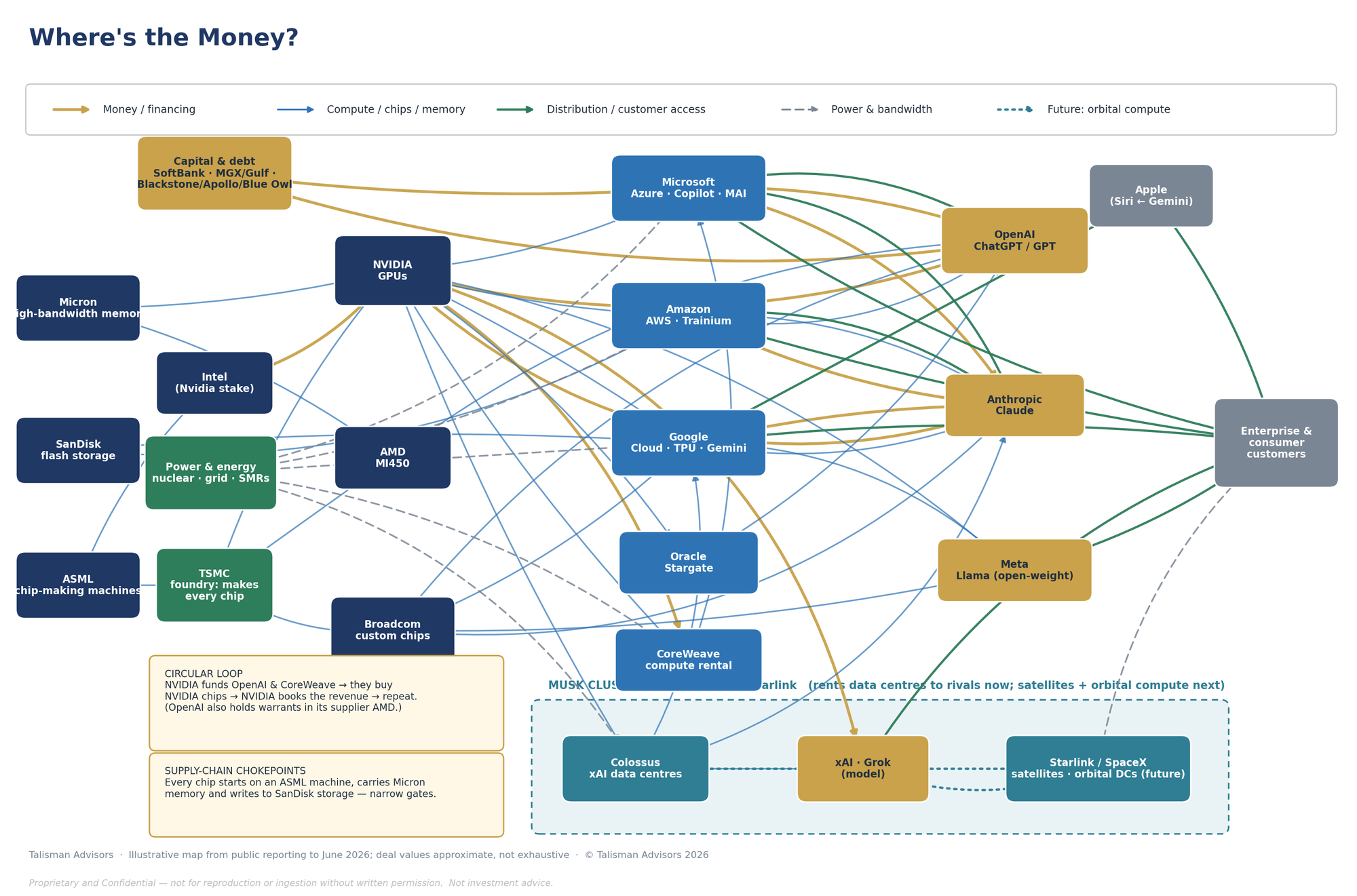
Unlike any other technology, AI has the capacity to impact, disrupt and change almost every market and create whole new markets. It can reduce costs of processing, increase quality of decision making, speed up conversion of information to action. It adds problem solving, diagnostics, decision making and task completion to applications and work processes; and, it creates new capabilities that would never be possible by humans. Finally, and perhaps most importantly, it will help to eliminate the scarcity of expertise.
It’s capacity to change how we live and participate in the world is unparalleled. It is also a key driver of GDP growth and long-term productivity improvements.
The paradox of the economics of LLMs
The headlines capture one half of the story: the staggering cost. The build-out of data-centres and chips grew so large that, in the first half of 2025, it accounted for the overwhelming majority of America’s economic growth. Strip out the AI build-out and the world’s biggest economy was close to a standstill. Over the full year the contribution was smaller — on the order of a fifth to two-fifths of growth, once imported chips are netted out — but the dependence is real, and it is why a stumble in AI spending would now be felt across the whole economy.
The headlines miss the other half. Even as the spending climbs, the price of using artificial intelligence is collapsing — exactly as it does with every digital technology. The cost of a unit of machine intelligence, measured at a fixed level of capability, has fallen by two to three orders of magnitude in about three years, and is still dropping at something like ten-fold a year. This is the ordinary physics of abundance: the cost of one more unit heads toward zero, and as the market swells toward ubiquity, the total cost follows it down. China presses the same lever from the other side, flooding the world with capable open models priced to undercut everyone.
So the paradox sits in plain view. Record sums going in. Collapsing prices coming out. And the companies whose names are synonymous with the technology losing money hand over fist. Spending like there is a bottomless pit of money; pricing for abundance.
The profit may not be where you think it is
Profit goes where value is delivered and where something is scarce. Where there is abundance and competition — increasingly the condition of the models themselves — profit thins towards nothing. So, follow the scarcity.
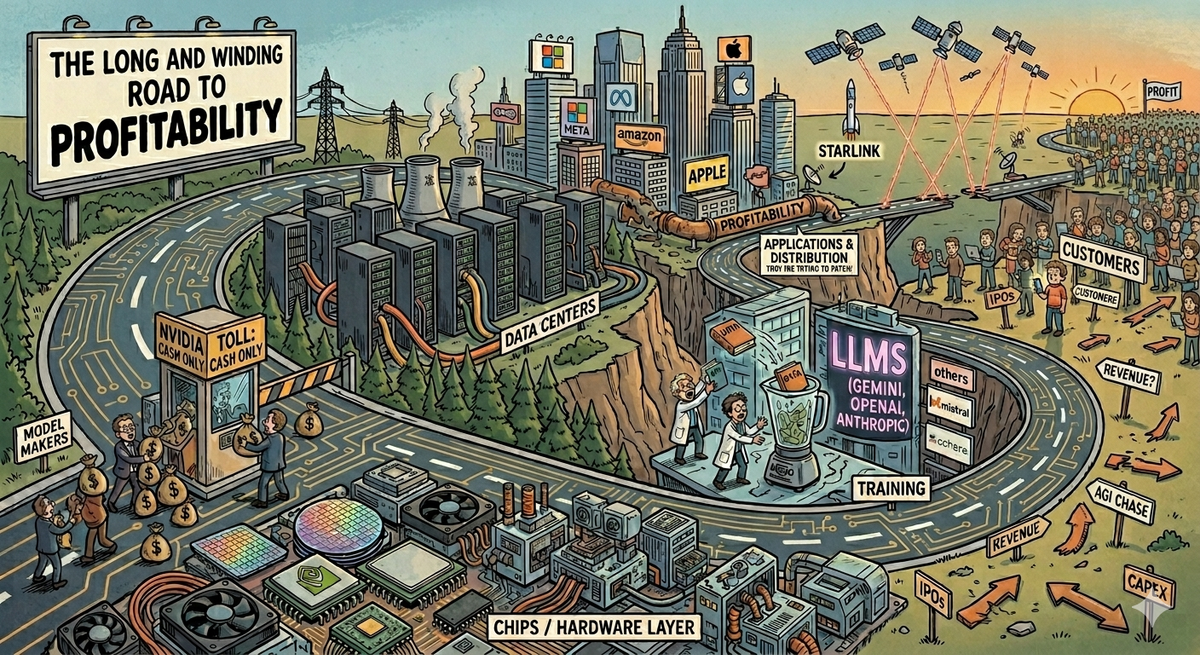
Today the money is startlingly concentrated. The great majority of the profit in artificial intelligence sits with the makers of chips and equipment — overwhelmingly one company, Nvidia, the dominant supplier of AI processors — and with the data-centre and cloud layer that houses those chips. By one reckoning, more than nine of every ten dollars of profit in the whole field sit in this hardware-and-infrastructure middle. The model-makers — the famous laboratories the public associates with AI — are, as a group, loss-making, spending far more on computing and training than they earn. The applications built on top are profitable but still small. It is just like the California gold rush - the people selling the shovels are making the money, and the people digging are not.
There is a circularity inside this almost too hard to believe. Nvidia invests in OpenAI. OpenAI uses the money to buy Nvidia chips. The purchase becomes Nvidia’s revenue, which lifts Nvidia’s value, which funds the next investment. The chip-and-cloud players that book the profit are bankrolling the very laboratories running the losses. It is a circle that integrates investment to create equivalent revenue growth and seems all self-supporting for the sector. Let’s hope the music of new capital doesn’t stop!
The future is an hour glass
The chase for value delivery will be downstream – labour augmentation, labour replacement, new markets, etc.; but the profitability will look like an hour glass. Scarcity and value moves, and profit moves with it. Over the next five to ten years, profit will evolve as scarcity changes and value is created. The money will move toward the companies that own the customer, the proprietary data and the applications, and, at the other end, toward the few genuine chokepoints, namely scarce electricity, the chip-making bottleneck and distinct hardware needs. The middle of the stack, data processing and the model-makers will likely still be squeezed.
China’s Mirror
China is running a parallel AI stack — the same six layers the West has (energy, chips, data centres, models, applications, and capital) — but built on different foundations and pointed at a different goal. Where the Western system is a capital-market stack — closed frontier models financed by private capital and hyperscaler capex, running on the leading-edge Nvidia–TSMC–ASML hardware chain — China's is a state-industrial stack: open-weight models pushed out as cheap commodity infrastructure, finance support by patient state capital and tech giants, running on a self-controlled hardware base.
China’s national build-out plan includes significant growth in both grid and data-centre capacity. It is not a copy of the West; it is a mirror built to run on different infrastructure and primarily domestic supplier centricity. China's genuine strengths cluster at the inputs and diffusion ends of the chain - energy, hardware volume, deployment, cost, application (including robotics) and open distribution.
The core difference is what each system is chasing. The West is in a race to AGI. While China optimises for leadership in market adoption and self-sufficiency — getting models into as many hands, factories, cars, and robots as possible, at a price the West cannot compete with. The West is in a classic VC style sprint, China’s is playing the long game, although with no less short term intensity.
Back to the IPO’s and the chase for profitability
Three companies with three different strategies. OpenAI focused on land-grab now, profit later. They have about 900 million weekly users. By mid-2026 they have reached a revenue run rate of $25 billion up from $10 billion a year ago. Their primary routes to market are through Microsoft and direct consumers subscriptions and usage-based enterprise and developer fees. They are also trying to drive down their costs by integrating into their own chips.
Anthropic has a narrow enterprise customer focus, with real strategic intent on sectors where the money is. They are highly application/agentic focused and already have built a strong reputation with Claude Code. Their routes to market are through all three major cloud ecosystems, and direct to customer sales. Their brand is ‘trust’. Their annual revenue run rate was $47 billion in May 2026, a five-fold rise in five months. Their cost management approach is to ensure there is diversification and competition across silicon/chips, compute providers and customer distribution.
SpaceX or Elon Musk is playing a very different game. His core positioning is as fully integrated player with particular strength as an infrastructure player. SpaceX is already a real profit engine that will only grow as it expands its network and coverage by providing satellite connectivity to the hard to reach and mobile needs, such as shipping and airlines, and then beyond. The reusable rocket business underpins the low cost launch of satellites and will also generate revenues from government and commercial launches. At the other end of the chain is Collosus the largest compute center in the world, already with multi-billion dollar contracts with Anthropic and Google. Musk also has the longer-term goal of orbital data centers. In the middle sits xAI, that drives X, has government contracts and is the key AI engine for Tesla. Of course, with Elon Musk you cannot ignore Tesla and its ultimate role in the AI game of robotaxis and vehicles, humanoids and other robotics deploying synchronous AI needing up to millisecond response times. Tesla has also developed their own presence in chip development.
The bets are big, the opportunities are there, and the expectations are high. How will this unusually interconnected frontier technology playout? The next 5 to 10 years will lock in the course of markets, winners and losers, and the paths to profitability.
This piece is commentary only. Figures are drawn from public reporting current to June 2026.