Read the Hand Before the Numbers Do
Reading the cards on leadership
On the evening of 26 May 2026, BP's board turned its chairman's cards over. Albert Manifold had held the seat ten months, brought in to run a reset and backed by the activist investor whose pressure had forced it. The board cited concerns about governance, oversight and conduct. By the next morning the shares were down nine per cent.
For one trading session the market did something it almost never does out loud: it priced leadership directly, in real time, with a number — not on a quarter's revenue, but on the strength of the play. And the signs that decided that morning had been sitting face up on the table for months, for anyone who knew how to read them.
This is about that skill: reading the hand before the numbers do. Not the personality of the player — the cards in play.
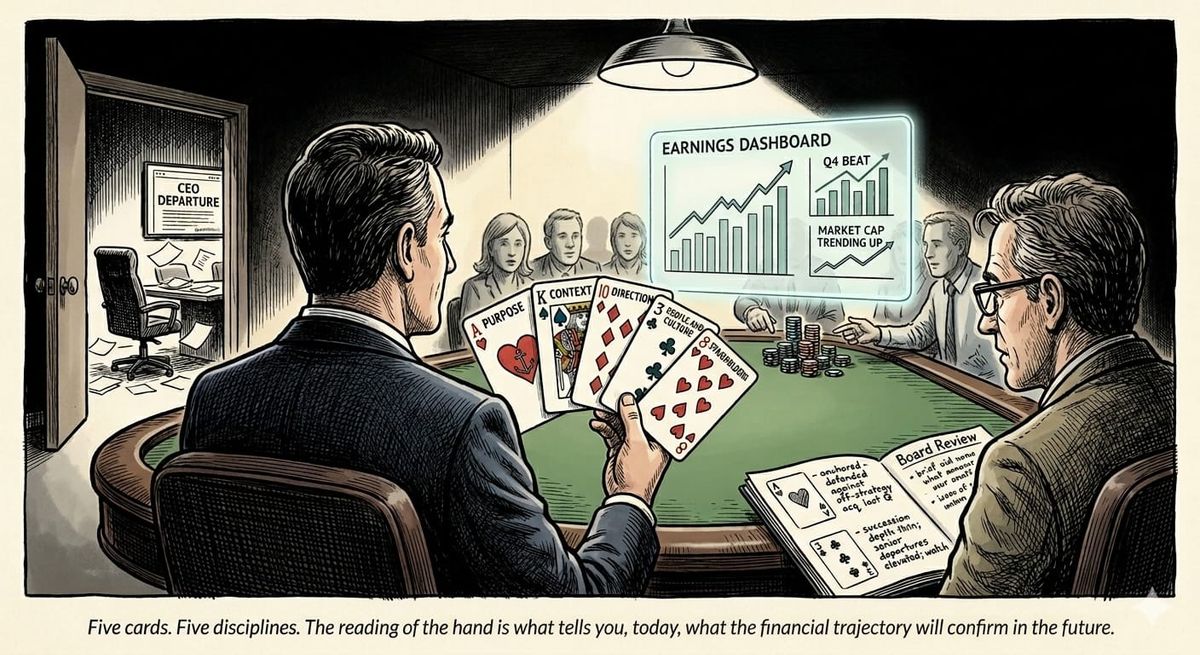
Most talk about leadership reaches for charisma, will and vision. The more useful picture is colder and structural: leadership at the top of a company is a hand of five cards that a chief executive has to build and play well.
Purpose —what the company is for agreed to by key stakeholders, defended under pressure, and used to prioritise opportunities
Context — the outside-in view of the rapidly change and increasingly complex world the company is playing in - technology, geopolitics, new ecosystems forming as old ones collapse. Used to make directional changes before the gap becomes punishing.
Direction — Strategy, structure, capital needs and allocation, focus across horizons - where to play, what to refuse, and whether you fight for a slice of a fixed pie (the zero-sum game) or grow the pie itself (the positive-sum game).
People and culture — the team, the cadence and habits, succession, the standards enforced even on the expensive cases, the bad news that travels fast enough to act on.
Stakeholders — the trust of everyone whose cooperation you depend on, built the slow way.
Two more things decide how the cards are played: judgment, knowing which to play and when; and character, which is mostly behaviour under pressure — exactly when the table is watching.
The earnings dashboard glowing on the wall is the chip count. It tells you who has been winning the pot to date. It does not tell you who will win the next game. The leadership read leads; the financial results lag — often by years.
Microsoft, 2014: late to mobile, search, cloud and social, its purpose drifted and its culture hardened into a know-it-all machine with ‘stack ranked’ people. Across the five, the hand was weak and falling. Satya Nadella rewrote the purpose, reset the culture from know-it-all to learn-it-all, and played the positive-sum game as the orchestrator at the centre of several ecosystems. The cards turned strong years before the three-trillion-dollar market capitalisation arrived. The chip count followed. It just followed later.
And because a method that only works on American chief executives is no method at all: in 2008 Berkshire Hathaway backed Wang Chuanfu at BYD, a battery-and-car maker in China most Western investors could not place, for 230 million dollars. Charlie Munger called him a blend of Edison and Welch. The stake went on to grow more than twentyfold. The hand was legible in Shenzhen long before the numbers confirmed it.
Boeing is the reverse — and the reverse is what fools people. Through David Calhoun's tenure the standard story was recovery according to the financials. The leadership signals said the opposite: a structurally compromised company on a flat trajectory when a steep improvement in engineering and quality was required. It said so for years before a door plug blew off a 737 in mid-air. The event was not the first evidence. It was the confirmation.
Disney taught the lesson twice. When Bob Iger first handed over, an excellent operator, Bob Chapek, was placed in a seat that needed a creative leader, and the company paid for the mismatch. When Iger returned, the man had not changed — the institution had: senior-team coherence damaged, trust frayed, succession broken. Individual character and institutional structure are not the same thing, and confusing them is how boards keep mis-reading their own companies.
None of this guarantees the pot. The market may not turn, a position may erode, a shock may swamp any leader. But a structurally exceptional hand and a compromised one carry very different odds — and those odds are what a board and an investor are really betting on.
So read the hand. It is legible in public: the annual report, the earnings call, the chief executive's own words, who just resigned, what the succession disclosures say. Five cards. Five disciplines. They tell you today what the financial trajectory will only confirm later — and the leaders, boards and investors who learn to read them will, over a long enough run of sessions, make materially better calls than those still waiting for the scoreboard to catch up.
© Talisman Advisors 2026.