Where Europe should win next
Old people, new grids, retiring machines, rising water, arriving robots, rails and rules — Europe's next big markets are in plain sight. The recipe for a winning start is clear.
Talisman Advisors © 2026
Kalundborg is a town of sixteen thousand people on a fjord in western Zealand, an hour and a half from Copenhagen, known — to the extent it is known at all — for an industrial park where one factory's waste steam heats the next factory's boilers. Novo Nordisk has made insulin there since 1969. Since 2021, the company has committed roughly $9.5 billion to expanding the site, one of the largest industrial investments in Danish history, because Kalundborg is where the active ingredient in Ozempic and Wegovy is made. In 2023, on the strength of what comes out of that town, Novo Nordisk became Europe's most valuable company.
You do not hear many recent stories like that from Europe. The story the continent tells about itself runs the other way: solar lost to China, batteries lost at home, the robot champion sold, the artificial-intelligence contest watched from the stands. None of it is false — it is just not the whole story.
Kalundborg happened too. Obesity medicine is a genuine market of tomorrow — a therapy class that barely existed commercially five years ago and is forecast by analysts to exceed $100 billion a year by 2030 — and Europe did not merely participate in it: a Danish company built on a 1923 insulin licence created the category and owned most of its opening years. So, the interesting question is not whether Europe can win markets that don't exist yet. It demonstrably can. The question is what the wins have in common, why the losses lacked it, and which of tomorrow's markets the recipe fits. A European board — or a finance ministry — should be able to name both: the recipe, and the markets to aim it at.
Start with what made Kalundborg possible. The capability is a century deep: Danish scientists brought insulin production home from Toronto in 1923, and the company has done almost nothing else since — a hundred years of accumulated skill in metabolic medicine and its manufacture. The capital is structurally patient: Novo Nordisk is controlled by a foundation holding a majority of the votes, which is why decades of unglamorous work on GLP-1 chemistry survived. A typical listed or private-equity-owned company would have killed the programme years earlier. The demand was institutional from birth: the company grew up selling to European public health systems — the largest, steadiest institutional buyers of medicine on earth. And the sequence matters: GLP-1 was a diabetes programme first — semaglutide was approved for diabetes in 2017 and only reached obesity, as Wegovy, in 2021. The health systems buying diabetes care, decade after decade, were unknowingly funding the molecule class, the manufacturing depth and the payer relationships that captured the market next door the moment it opened. The first customer does not have to buy the future directly; it can fund the capability in an adjacent market. A path for capability building, capital that does not flinch, an institution acting as anchor buyer. Keep those in mind, and run the pattern across Europe's other wins.
Airbus was developed in 1970 out of exactly that arithmetic: governments provided launch aid, and state-influenced flag carriers provided the first orders, for an aircraft consortium nobody in the private capital market would have financed against Boeing. Denmark's other export miracle runs on the same logic — a feed-in tariff for wind power introduced in 1979 guaranteed a price for every kilowatt-hour, and the guaranteed demand built Vestas, today the world's largest turbine maker, and turned a state oil company into Ørsted. ASML, the Dutch lithography monopolist on which every advanced chip on earth depends, was spun out of Philips in 1984 and carried through its unprofitable decade by Philips's balance sheet and European research consortia. Different countries, different sectors, one mechanism: in most markets of tomorrow Europe has won, an institution bought the market into existence before it was a market, and patient capital held the position until the buying arrived.
Now run the losses. Germany's Q-Cells was briefly the world's largest solar-cell maker; it went insolvent in 2012 and was bought by a Korean group, because a German subsidy scheme that paid households to install panels created demand that Chinese manufacturers, with cheaper capital and faster-built capacity, were free to serve. KUKA, the Augsburg robot maker that was Europe's champion in the automation century, was sold to China's Midea for €4.5 billion in 2016 — capability without a committed owner. And Northvolt, the great European battery hope, raised more than $14 billion — more than any European start-up in history — and filed for bankruptcy in Sweden in March 2025, having lost a $2 billion BMW order it could not deliver. The losses are not stories of missing technology or missing money. Q-Cells had the technology; Northvolt had the money. What every loss was missing is the thing every win had: an anchored buyer and an owner built to wait. Subsidy created markets that others supplied; capital arrived without the customer that disciplines it. The visible symptom, in the post-mortems, is usually lateness — Europe reached batteries a decade behind CATL — which is an outcome, not the cause. Having the right conditions to be early in an emerging market is what is vital. Without an early buyer, a market becomes visible only when the trade statistics announce it, and early market positions and requisite capabilities are already established. Europe’s failures were missing essential ingredients for success.
That is the recipe, then: a path for capability building, patient ownership, an institution as first customer — and, running underneath all three, rules that travel, because Europe's product standards follow its purchases into the world market. The question that matters is where it applies next. Six markets qualify: each large by 2035, each still early enough to shape, and each with the rare property that the demand already is clear and will exist at scale.
The first is the longevity economy. Europe is the oldest rich region on earth; its working-age population has been shrinking since around 2010 while the number of over-80s climbs for three more decades. That is usually recited as a burden. Read it as demand: care delivery, prevention-based medicine, and the fusion of pension, insurance and health products that ageing forces — sold first to the world's most complete welfare states, which is to say, to the anchor buyer already in place. Kalundborg is the existence proof that European health systems can pull a world-beating industry into being. The honest complication belongs here too: Novo's shares have fallen by roughly two-thirds from their 2024 peak as America's Eli Lilly presses it — proof that winning a market of tomorrow opens a contest rather than ending one. The recipe builds leadership positions. It does not retain them – that is a separate discussion.
The second is electricity systems. The European Commission's own arithmetic says the grid needs €584 billion of investment this decade — forty per cent of the distribution network is more than forty years old — while the International Energy Agency projects world data-centre power demand nearly doubling to 945 terawatt-hours by 2030. Europe's post-2022 energy costs are a competitive wound; the build-out that heals it is one of the largest guaranteed home markets on the continent, spanning grid equipment, storage, interconnectors and a reviving nuclear programme. And Europe still holds supply positions worth anchoring: the world's largest cable maker is Italian, its grid-technology leaders are German and French, and every kilometre of high-voltage line ordered at home is capability for export.
The third is the recovery economy. Rare-earth magnet metals are refined almost nowhere outside China — the IEA puts China's share near 90 per cent — and end-of-life recycling of them runs below one per cent. Yet one of the largest future deposit locations of these metals is in Europe: the motors, turbines and batteries installed in the 2020s begin retiring from the early 2030s, a local high-value resource accumulating in plain sight. The law already exists — the Critical Raw Materials Act requires a quarter of the EU's consumption to come from recycling by 2030 — but a benchmark is not a buyer. Mandated recycled content in public procurement, and the industry assembles itself around the order book on European soil this decade.
The fourth is insurance for a hotter world, and the numbers deserve a moment, because they describe a market being created by the weather itself. 2025 was the sixth consecutive year in which insured losses from natural catastrophes passed $100 billion, and the composition has changed in a way that matters: a record 92 per cent of those losses came not from the rare great earthquake but from the disasters that now arrive every year — wildfires, floods, hailstorms — with January's Los Angeles fires alone costing $40 billion, the largest insured wildfire loss ever recorded. Yet in Europe, only about a quarter of catastrophe losses are insured at all —which, in plain terms, means three of every four euros of flood or fire damage land on the household, the business, or the taxpayer. A gap that wide, growing that fast, is an emerging crisis; it is also the design brief for a market the entire warming world will need, because everything a hotter century requires — cover priced to reward flood defences rather than punish postcodes, public-private pools that keep risky regions insurable, catastrophe products for places that never had them — has to be invented by somebody in the next decade. The incumbent capability is already European: the three largest reinsurers on earth, Munich Re, Swiss Re and Hannover Re, have been pricing disaster since the age of steam and are emerging from the hardest insurance market in a generation exceptionally profitable. What the market lacks is its first customer — and one is on the table, in the European supervisors' own proposals for an EU-level catastrophe backstop, which would do for adaptation insurance what launch orders once did for aircraft. Whoever architects the machinery that keeps a warming world insurable will export it everywhere the climate bill lands.
The fifth is robots. This is a market Europe must at least secure positions in critical sectors and key points in the value chains. Europe’s current industrial position is sobering. Western Europe's factories run 267 robots per ten thousand workers and Germany 449 — but South Korea runs over a thousand, China has already overtaken Germany and Japan in density while installing roughly half the world's new robots, and the humanoid generation now arriving is overwhelmingly Chinese-built. Europe should not treat its own enormous forthcoming demand as a passive import bill. Demand is leverage. Aggregate the orders — healthcare and eldercare, defence and security, warehouse and logistics, agriculture and dairy, infrastructure management, municipal services — and make localisation, standards and security the price of the contract.
The sixth is rails and rulebooks — the payment, identity and data infrastructure the century runs on — and the whole of it is contained in two proofs, one Indian and one American. India built its digital plumbing as public goods — identity, consent, and a payments rail, UPI, that now carries the dominant proportion of the world's real-time transactions — and is exporting the stack across the middle-income and developing world precisely because it is the sovereignty-preserving option, beholden to neither Washington's platforms nor Beijing's. The American proof is the warning — how this market is lost. Europe wrote the world's data rulebook — the GDPR, the Brussels effect at full power — and declined to build the operators: roughly 70 per cent of its cloud now runs on three American providers, whom American law reaches wherever the servers stand, and the dependency runs all the way up the stack to the analytical layer through which states themselves see — the European health services, police forces and NATO commands that run their sense-making on Palantir, an operator seeded by the CIA's venture arm and grown on Pentagon anchor orders: the first-customer recipe, executed by somebody else's state.
Europe holds the cards to answer both proofs — the digital-identity wallet every member state must issue by the end of 2026, the digital euro, the attestation systems machines will need to trade with one another, and security and defense budgets that could grow European operators of its own. Rules without operators built the world's best-protected dependency; rails, wallets, clouds and the software that watches over them become a market on the day an anchor customer orders them.
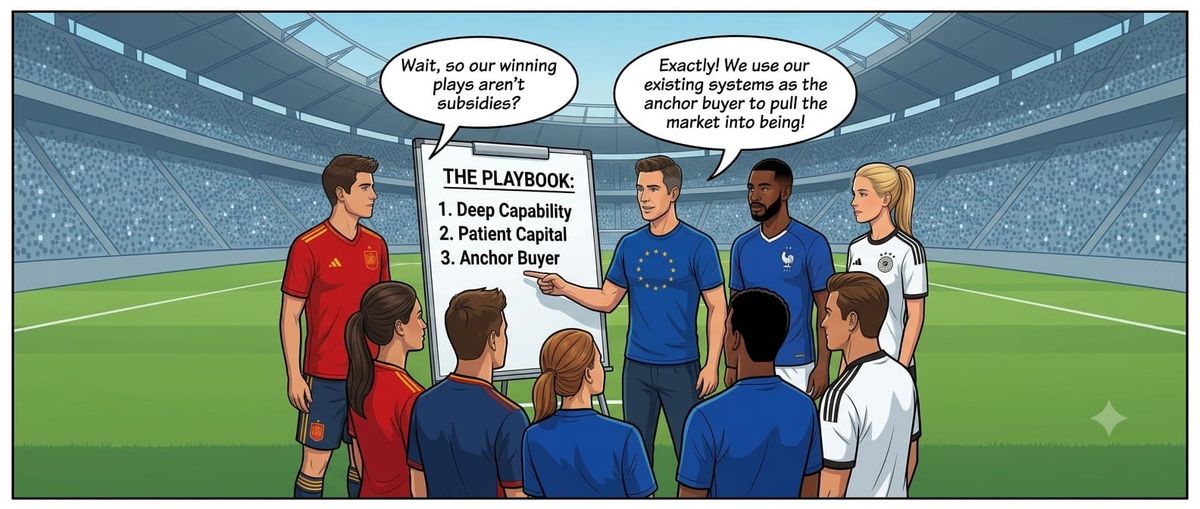
So, the recipe one last time: Europe wins markets of tomorrow when deep capability meets patient capital and an institution anchors the early orders — the orders that sets the clock, and starts the volume that drives the learning curve down to meet competition — and it loses them when subsidy or sentiment substitutes for a customer and entry waits on proof that only arrives, years late, in the trade statistics. The uncomfortable implication is that Europe's most powerful industrial instruments are not in its industry ministries at all. They are its health systems, its utilities, its municipalities and its insurers — the largest institutional buyers in the world, currently purchasing yesterday's products and not driving their purchases at tomorrow’s needs. Aiming them is not a subsidy programme, it is an enabling program. A procurement mandate scaled across the single market is the one critical capacity instrument twenty-seven countries must operate to create a more level playing field.
The recipe is where to start, but doesn’t guarantee long-term success. Anchor buying can turn into captive mediocrity if there is no competition. The lessons of the US and China point to intensive early competition leading to world-leading companies with deep commitments to continuous evolution and development to maintain leadership. The discipline that made Kalundborg was global competition on top of home demand, not instead of it. Novo's drop from peak value shows that no position is safe once won. Ambition beyond home borders is essential. This is a discussion about execution, not that the core demand does not exist. The demand — old people, new grids, retiring machines, rising water, arriving robots, rails and rules — is certain.
Which returns us to the town on the fjord. In 1969, nobody in Kalundborg thought they were hosting the future; they were hosting a factory that sold medicine to health services, decade after unremarkable decade, until the century of capability and the patient owner and the institutional buyer compounded into the most valuable company in Europe. Their challenge now is to continue to be a winner in the global obesity market over time and enter new adjacent markets for the GLP-1 molecule. At least six markets are ready for growth and development. The question for a European board, or finance ministry, is how can you create the next Kalundborg?
This is commentary, not investment advice. Figures are drawn from public reporting current to July 2026.