The Wolf in Sheep's Clothing
An ecosystem ready to fail?
This piece first appeared on LinkedIn, where it reached over 365,000 readers. It opens this publication.
Four weeks ago, on the A4 to Heathrow, my Uber driver explained why the £47 trip I had booked was cancelled — and why he had then accepted the same drive a few seconds later for £10 more.
His first screen offered him £18. He turned it down. Thirty seconds later the trip came back as an Uber Comfort: passenger £57, driver £23. He took it. I made the flight.
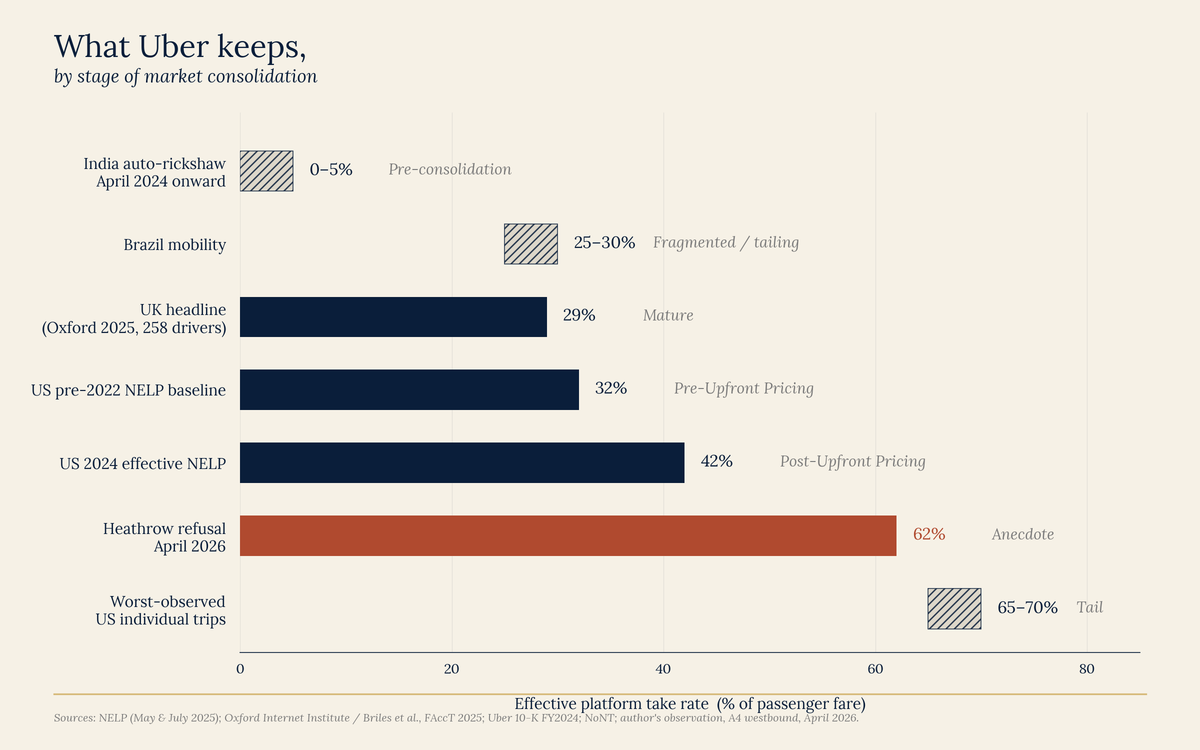
What sat between £47 and £18, and then between £57 and £23, was Uber. Twenty-nine pounds — 62 percent of the original fare — decided by an algorithm on a Thursday morning in west London. There were no takers at £18. There was one at £23. The platform pocketed the difference.
For most of Uber's life, this could not have happened. Before 2022, the passenger price and the driver share were the same number multiplied by a transparent commission. In March 2022, Uber switched US markets to algorithmic Upfront Pricing, and over the following eighteen months rolled it out across most of the developed world. The passenger now sees a price built from their device, their destination, the time of day, the weather, and — according to researchers who have reverse-engineered the system — their past willingness to pay. The driver sees a separate offer. The two numbers are no longer related. Uber sits in the gap and decides how wide it gets.
The National Employment Law Project calculates that the share Uber keeps of the US passenger's fare has risen from about 32 percent before 2022 to 42 percent today, with individual trips reaching 65 to 70 percent. An Oxford team tracking 258 London drivers across 1.5 million trips found inflation-adjusted earnings have fallen from over £22 an hour to just over £19 — while passenger fares rose.
Predatory pricing in the textbook sense means pricing below cost to kill a competitor. The version that matters here is different: pricing one side of a marketplace below the level at which it can sustainably participate, while that side has no realistic short-term alternative.
Every multi-sided business runs on an implicit covenant. Every participant has to benefit over time — not every trip, not every quarter, but over a horizon long enough that drivers, passengers, restaurants and the platform itself stay in the game willingly. This is not an ethical principle. It is an engineering one. A marketplace in which one side is consistently priced below sustainability is a marketplace quietly emptying out from that side, long before the operator notices.
Amazon understands this. It takes around 15 percent from third-party sellers and invests heavily to make those businesses bigger over time. Airbnb hosts earn more than before Airbnb existed. Shopify's merchants grow. The platforms that compound do so because their arithmetic works for the people they sit on top of.
Uber's no longer does. The company posted its first profitable year in 2023 — eighteen months after Upfront Pricing rolled out. The pivot to profit was not earned through scale, productivity, or the long-promised arrival of autonomous vehicles. It was financed by widening the spread.
Two consequences follow.
First, a 42-percent average take — the share of the passenger's fare the platform keeps — with 65-percent peaks is a 25-to-30-point invitation to any competitor willing to charge 15 percent. The dissatisfied driver and the overpaying passenger are not edge cases. They are the network. In India, Rapido and the non-profit Namma Yatri have already pushed Uber into zero-commission auto-rickshaw pricing. AI has cut the cost of building the matching engine, dispatch logic and customer service operation by an order of magnitude. The umbrella under which a leaner alternative can grow is now very wide.
Second, the food chain. The trick that worked when Uber was at the top — extract from the side that cannot leave — does not work when Uber is in the middle of a chain whose upper layers are Alphabet (Waymo), Amazon (Zoox), and Tesla. Waymo already runs its own consumer app in cities where it has built brand density; it uses Uber's dispatch only in cities where it has not. The carmakers and autonomous-vehicle developers building the next layer of capital have their own apps, their own customers, their own balance sheets, and very specific reasons to bypass an aggregator that would otherwise compress their margin. Predatory behaviour at the top of a chain looks like dominance. In the middle of a chain whose upper layers can swallow you, it looks like something else.
The driver dropped me at Terminal Five with fourteen minutes to spare. He was the kind of person the platform should most want to keep — professional, polite, well-rated, willing. The system had decided that morning that an hour of his time was worth £18. He took the £23 version because something was better than nothing. He was not getting richer. He was not getting more customers. He was not, on any horizon that mattered, benefiting from the business he was holding up.
A platform that consistently extracts more from its participants than they can sustainably give stops being a platform and becomes a counterparty — the other side of the deal. The brand stays the same. The app stays the same. The talk of community stays the same. The transaction underneath does not.
The question is no longer whether Uber is running its multi-sided marketplace fairly — passengers and drivers have already answered that for themselves. The question is who builds the alternative, and whether the players higher up the autonomous-vehicle food chain will let Uber be the one who aggregates them.
How long do you think the wolf can keep wearing the sheep's clothing?