Plastic - The Material That Will Not Leave
Why the market is looking at the wrong end of the barrel—and how a wall of back-end regulation is re-pricing the world’s most permanent commodity.
Talisman Advisors © 2026
The Rotterdam Filter
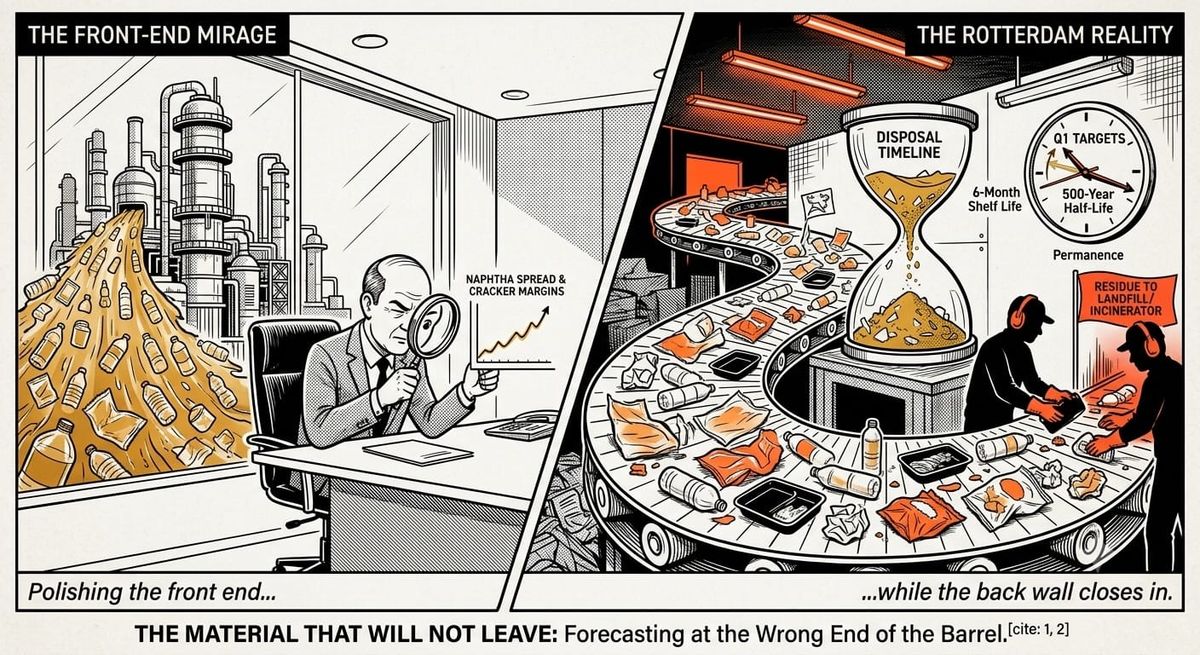
Just after midnight on the edge of Rotterdam, a sorting line runs under white light while the city sleeps. A conveyor carries a river of household waste past banks of optical scanners that fire jets of compressed air, knocking each fragment into its lane — clear bottles here, coloured jugs there, film to a third. At the end of the belt two people in gloves and ear defenders do the thing the machines still cannot: they pull off what the scanners misread. The black meat tray the near-infrared sensor cannot see against the belt. The crisp packet that is really a wafer of aluminium laminated between two different polymers and belongs to no lane at all. The squeezed pouch, the sticker-clogged tub.
By the time the stream reaches their hands, a large share of what arrived "for recycling" has already been peeled off as residue—bound for an incinerator or a hole in the ground. Much of what survives will be baled and offered to a market that, since 2018, has largely stopped buying.
You know the numbers. The world made something like four hundred and fifty million tonnes of plastic in 2024, it grew more than four percent that year, and only about nine percent of what becomes waste is ever genuinely reprocessed. You know the feedstock is overwhelmingly fossil — an oil barrel's afterlife — and that the industry's own low-cost giants in the Gulf and the American shale patch have built so much cracker capacity that integrated margins have been under water since the middle of 2022.
The purpose of this piece is to argue that the market is watching the wrong end of this business. The variable which will actually set its future is not the naphtha spread or the demand curve, but a wall of law now closing on the back end, and a treaty that failed in a hall in Geneva last summer. Plastic’s genius is that it is cheap, light, sterile, and effectively permanent — and its curse is exactly the same sentence. We took the most long-lasting everyday substance mass-produced and used most of it for objects we throw away in minutes. A packaging film has a working life of about six months; the polymer it is made from will outlast the person who discarded it by centuries. That mismatch is not a detail. It is the whole story, and it is why the fate of this industry is being decided not where the stuff is made but where it goes to die.
Two Speeds: Six Months vs. Forty Years
Walk the demand outward and you see how wide the range of end products really is, and how sharply it splits in two. A little under forty percent of everything produced goes into packaging — the throwaway heart of the business, and by tonnage its single largest and shortest-lived use. Another fifth goes into building and construction, where the same polymers do the opposite job: pipes, window frames, cable sheathing, insulation foam, all of it designed to sit in a wall for three or four decades. Between those two poles sit the rest — the parts of a car, where lightness buys fuel economy; the housings and boards of every electronic device; the fibres of most modern clothing, a use so large that if you counted textiles in the same frame as everything else, polyester would stand among the biggest applications of all; the films and drip-tape of modern farming; and the vast, unglamorous world of medical single-use, where sterility is the whole point.
Each of these has its own workhorse polymer, and the shelf is more varied than outsiders assume. Polyethylene, in its several densities, makes the films and bottles and pipes. Polypropylene makes the caps, the tubs, the car bumpers, and a great deal of fibre. Polyvinyl chloride is the workhorse of the built environment — window frame, drainpipe, flooring, cable. Polyethylene terephthalate (PET) is the clear bottle and the polyester thread. Polystyrene is the insulation board and the protective pack; polyurethane the foam in the mattress and the cavity wall. The category is not one substance but a dozen, each made for purpose in its own niche and incomplete outside it — and that is the fact most demand models flatten into a single line called "plastics."
The split between the six-month life and the forty-year life is the one that matters for everything that follows, because the waste, the outrage, and the regulation all concentrate at the throwaway end.
The Substitution Mirage
For a decade the loud story has been substitution — the search for something, anything, to put in place of the fossil polymer. Watch the retreats and you would think the material is in flight. Supermarket chains move to paper wrap and moulded-fibre trays. Drinks brands trumpet aluminium and glass. Cutlery, straws, stirrers, foam cups and cotton buds have been banned outright across the European Union since 2021. A whole industry of bio-based alternatives — corn-derived PLA, microbial PHA, sugarcane polyethylene — promises a benign twin of every polymer on the shelf.
But look at where each of these actually stands and a very different picture appears. After thirty years of effort and subsidy, everything the world calls "bioplastic" adds up to roughly half a percent of production, and on the most generous definition still only around one percent by the end of this decade. The banned single-use items are real, but by tonnage they are close to symbolic: plastic straws, the most famous target of all, are a fraction of one percent of what reaches the ocean. And the substitutions that regulation and shopper sentiment are pushing hardest — paper for film, glass for the bottle — turn out, under the cold light of a life-cycle study, to be very often worse. A peer-reviewed survey last year found that across sixteen common uses spanning most of world volume, the fossil polymer was the lower-carbon choice in fifteen of them. A Danish government study calculated that an organic-cotton tote must be reused thousands of times across the full range of environmental harms before it repays the single lightweight bag it replaces. A glass bottle carries several times the carbon of the clear polymer one it is meant to virtuously supplant, because it weighs twenty times as much and has to be dragged around the country. And the quiet champion of the whole class — the barrier film that lets a cucumber last three times longer, the wrap that turns a week of shelf life into a fortnight — prevents food waste whose avoided emissions dwarf the wrapper many times over.
This is the point the market misreads. The substitution pressure here is not, in the main, a story of a better product winning on merit, the way cheaper synthetics once beat natural fibres. It is a story of politics and perception — of a "paper good, plastic bad" instinct that researchers can now measure in the laboratory, shoppers rating a package greener precisely when it uses more total packaging. Where the fossil polymer is doing real work — holding a sterile field in an operating theatre, keeping food edible across a continent, taking weight out of a car, keeping the heat inside a house — nothing has displaced it, because nothing else does the job as well or as cheaply for the price. The substitutes advance where the stakes are symbolic and stall where the stakes are physical. That asymmetry is worth far more to your model than any tonnage of announced bio-capacity.
The Nine-Percent Fiction
Which brings us to the story the industry most wants to tell and least deserves to. The word "recycling" sits on the side of every bottle and in the sustainability section of every annual report, and it describes something that, at the scale implied, does not happen. Of all the polymer waste the world generated in the most recent full accounting, about nine percent was actually reprocessed. Roughly half went to landfill, a fifth was burned, and more than a fifth was simply mismanaged — dumped, littered, or burned in the open. The gap between the fifteen percent collected with recycling intent and the nine percent that survives the process is what is lost at that Rotterdam belt and every stage after it: the wrong polymer, the food-fouled tub, the laminate that cannot be separated.
Two deeper facts keep the rate where it is. The first is that reprocessing degrades the material. A clear bottle can be melted and reformed only a handful of times before the polymer shortens and yellows, and the dominant route for a recovered bottle is not another bottle but a lower-grade fibre — a one-way step down the ladder of value that the trade politely calls downcycling. Food-contact rules make the descent almost mandatory: European safety authorities require that recycled feedstock going back against food be almost entirely of food-grade origin, which most collected waste is not. The second fact is that the escape valve has closed. Until 2018 the rich world exported a great deal of its waste to China, which took perhaps half the global trade; when Beijing shut the door with its National Sword policy and the Basel Convention then tightened the rules on shipping the stuff across borders, the exported problem came home, and the true domestic rate stood revealed.
Against this, the industry has placed a large bet on chemical recycling — cooking waste back into oil or its original building blocks rather than melting it. The chemistry is real and a handful of plants now run: a methanolysis unit in Tennessee turning polyester back into monomer, a pyrolysis line in Texas breaking mixed waste into feedstock. But the honest tally is sobering. The world's operating advanced-recycling capacity is a rounding error against the waste stream. Even in the United States, where it is most built out, its nameplate capacity is barely one percent of domestic plastic waste, with real output a small fraction of that. Much of the output becomes fuel to be burned rather than new material, headline projects have been cancelled or delayed through 2025, and the paper-attribution accounting method the sector wants to use is being fought over precisely because it flatters the number. The permanence that makes the material useful is the same permanence that defeats its disposal: production grows at four percent a year, reprocessing is stuck near nine, and the two lines are diverging, not converging.
Regulatory Traps and Geneva Stalemates
If none of that is new to you, here is what should reframe the year. The pressure that will actually move this market is no longer coming from the substitutes or from the recycling line. It is coming from the law, and it is arriving from two directions at once — one that has landed and one that failed.
The one that has landed is European, and it works from the demand side. The Union's new packaging regulation, in force since early 2025 and biting from August 2026, does not ban the material; it does something more consequential. It mandates minimum recycled content in it — thirty percent in many food-contact bottles by 2030, rising toward half and more by 2040 — and in doing so it manufactures, by statute, a statutory demand for recovered feedstock the recovery system cannot yet supply. You can watch the result in the price. Recovered food-grade bottle flake traded through 2025 at a premium of several hundred euros a tonne over the virgin resin it is mandated to replace — the market pricing a shortage that a regulation created — and the spread has stayed stubbornly wide into 2026 as a wave of cheap imported virgin has pulled the two further apart. An eight-hundred-euro charge for every tonne of packaging waste a country fails to recycle, a British tax on any packaging that falls short of a recycled threshold, an extended-producer-responsibility fee in one country after another: each is a small machine converting an environmental externality into a line on a cost sheet, and together they are re-pricing the material from the waste end forward.
The one that failed is global, and its failure is as instructive as any success. For three years the world's governments negotiated a United Nations treaty on plastic pollution, and the whole contest came down to a single question: would the treaty cap how much of the material gets made, or would it only tidy up the waste after the fact? A coalition of more than a hundred countries, led from Europe and by a determined Panama, wanted binding limits on production. A smaller group of oil-producing states, with Saudi Arabia at the front, would not allow the word "production" to survive in the text. When the delegates gathered in Geneva last August for what was meant to be the final session — some fourteen hundred government delegates, from a hundred and eighty-three countries, shadowed by at least two hundred and thirty-four fossil-fuel and petrochemical lobbyists — a record turnout that outnumbered the entire European delegation — they adjourned without a treaty and without even a date to reconvene. The talks have since limped back into motion, with a new chairman, a roadmap, and informal sessions penciled in through 2026, but the production cap remains blocked and no one expects it soon. For the foreseeable future, every constraint that binds this material will come from the demand side, one jurisdiction and one regulation at a time.
That outcome sits on top of a fact the energy world has only recently absorbed: as the world's demand for fuel to burn approaches its peak, the oil industry's growth now depends on turning crude into this material instead. By the reckoning of the International Energy Agency, petrochemicals become the dominant source of oil-demand growth from around this year, with polymers and fibres accounting for something like one barrel in every six by 2030. The producers' single largest bet on future volume is precisely the very substance the failed treaty was trying to contain — which is why the fight over it was never really about litter, and why it will not end in Geneva.
Beyond the Cracker: A New Desk Model
So here is the argument, once more and plainly, for the desk. The market reads this as a petrochemical volume business — priced on feedstock spreads, cracker utilisation, and demand that rises with global income — and on that reading it is a story of oversupply and thin margins waiting for the next upcycle. That reading is not wrong about the front end. It is simply looking at the end of the business where the money is easiest to model and the future is least decided. The future is being decided at the other end, in the widening gap between a substance made faster every year and a recovery system stuck at nine percent, and in the wall of demand-side law that a failed treaty has now left as the only instrument in the room.
The analyst who spends the next year refining a naphtha-to-ethylene margin model is polishing a real but shrinking part of the picture. The questions that will actually move this market are how fast the recycled-content mandates outrun the supply of recovered material, and what that does to the premium and to virgin demand; whether chemical recycling ever crosses from press release into a tonnage that matters, or remains a licence to keep making the virgin material with a cleaner conscience; which brand pledges quietly die next, now that the biggest names have already walked their 2025 targets back; and what a hundred countries do unilaterally, from the demand side, now that they cannot do it together. Those are not commodity questions. They are questions about what a society decides to do with a material it cannot stop making and cannot make disappear — and they lead, every one of them, back to two people at the end of a belt outside Rotterdam after midnight, pulling off the things that were never going to be recycled, in a system built to look like it works.
Talisman Advisors combines analytical frameworks, methodologies, terminology, scoring constructs, panel data, and AI to create interesting, instructive and insightful content. There may be hallucinations that have not been found. Any use of this material for any purpose is strictly your responsibility.